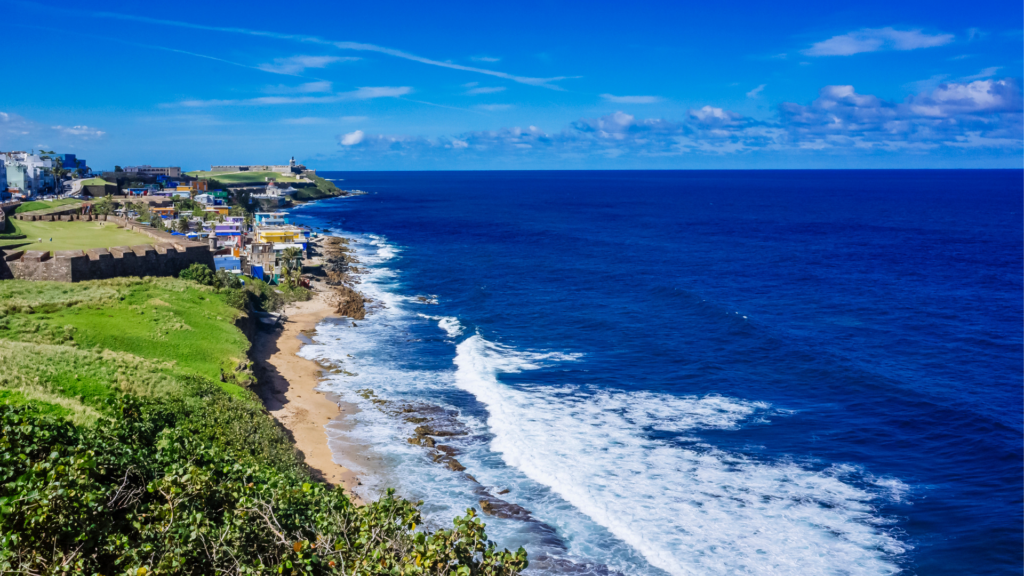
The development of offshore aquaculture, particularly in emerging regions, requires detailed planning and meticulous analysis to address the uncertainty created by the absence of an established industry. Innovasea is leading a Sea Grant-funded project to plan a new commercial open ocean fish farm off the west coast of Puerto Rico.
To help with project planning and to serve as a communication tool with regulators, local stakeholders, and potential project partners, long before fish are in the water, Innovasea created a production plan. In it, we outline the size of the farm and how fish will flow through the various farm stages.
This practical blueprint for how to translate data such as growth models, environmental data, and market realities into a scalable farm design, offers a detailed look at how disciplined production planning can de-risk projects and optimize performance.
Continue reading to learn what’s included in the report or download the report in English or Spanish.
Production planning as a core element of farm success
Production planning serves as the link between biology and infrastructure and enables farmers to utilize assets to their capacity, increasing the throughput of farms.
The analysis emphasizes:
- Matching production volume to market deman
- Designing assets to avoid bottlenecks or underutilization
- Sequencing fish cohorts to maintain continuous flow
- Building operational buffers to handle variability
Farm design
A phased development strategy is a prudent approach, particularly for farms tackling new species or production regions. The plan for a Puerto Rico farm is to begin with 4 pens, producing an expected 800 tons of red drum per year.
This will offer the farm a manageable starting point while still providing a commercially viable harvest volume, with the ability to grow organically based on market demand, availability of fingerlings, and the success of the farm.
The site plans to source fingerlings from a 3rd party supplier and stock them in nursery nets inside the grow-out pens during this initial phase of farm development. This approach conserves capital and allows for simplified operations and skill development with less cash at risk during the early farm years. Furthermore, it enables the farm to reinvest retained earnings to reduce equity dilution during expansion.
Accounting for juvenile scarcity
Because juveniles are not widely available for most tropical marine species, relying on a single supplier creates a business risk. Production issues for a 3rd party supplier can create outsized issues for a farmer relative to the hatchery, misaligning the incentive to hit production goals. Further, the sole supplier of an important input has significant pricing leverage over the farm.
As such, the Puerto Rico farm plans to build their own land-based hatchery once farming operations are stable. This approach initially conserves capital, lessening the financial burden until production methods are validated, and market demand is established.
With the later creation of an on-site facility, the farm will reduce the cost of fingerlings by purchasing smaller larva while introducing larger fish into the offshore pens. This reduces mortality and shortens the offshore growing cycle. Furthermore, it mitigates the single-supplier risk since land-based facilities can be used to incubate eggs and raise larva if necessary.
The value of reducing the length of the net pen stage of the production cycle is often overlooked, but it is hugely influential on farm revenue. Stocking tiny fish into a large net pen is a very poor utilization of that space. So, although holding fish on land adds costs that are not required offshore (pumping water, gas management, etc.), the opportunity cost of occupying a pen with very small fish is usually greater making it a better financial decision to stock larger juveniles.
Growth models and production benchmarks
The Puerto Rico farm anticipates the following grow out cycle times:
| Species | Harvest size | Full cycle time | Net pen occupancy |
| Red drum | ~1.4 kg | 13 months | 9 months |
| Red snapper | ~750 g | 12 months | 8 months |
| Almaco jack | ~3.5 kg | 17 months | 13 months |
These timelines reflect:
- Warm-water growth advantages
- Stable environmental conditions
- Moderate production intensity
Notably, specific growth rates (SGR) follow expected declining curves from larval to harvest stages, reinforcing that accurate life stage-specific modeling is critical for bio-plan reliability.
Production Scenarios
The report creates production models for four core production scenarios. Each scenario represents a potential operating state for the farm, which will be further evaluated through a financial model. The inclusion of 3 species allows for flexibility if a species is deemed unsuitable as the large project viability assessment progresses. A few standout benchmarks:
Red Drum (4 Pens – Early Stage)
- Output: 800 tons/year
- Juveniles required: 840,000
- Feed demand: 1,675 tons/year
Red Drum (8 Pens – Mature)
- Output: 3,000 tons/year
- Juveniles required: 2,500,000
- Feed demand: 5,600 tons/year
Red Snapper (12 Pens)
- Output: 5,900 tons/year
- Juveniles required: 8,000,000
- Feed demand: 8,900 tons/year
Almaco Jack (12 Pens)
- Output: 1,900 tons/year
- Juveniles required: 1,120,000
- Feed demand: 4,900 tons/year
Next steps
The production plan is a key building block for farm planning that builds upon the species selection work. However, this work is only partially complete.
The team is nearing completion of the site selection analysis, which is the next expected project output. That will enable site characterization studies which are scheduled for the fall. This will enable the team to do preliminary system design work and refine their expectations for capital requirements for major pieces of farm infrastructure. These key inputs are critical for a financial model, which is a major piece in creating a robust and defensible farm plan.