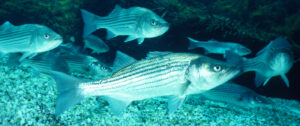

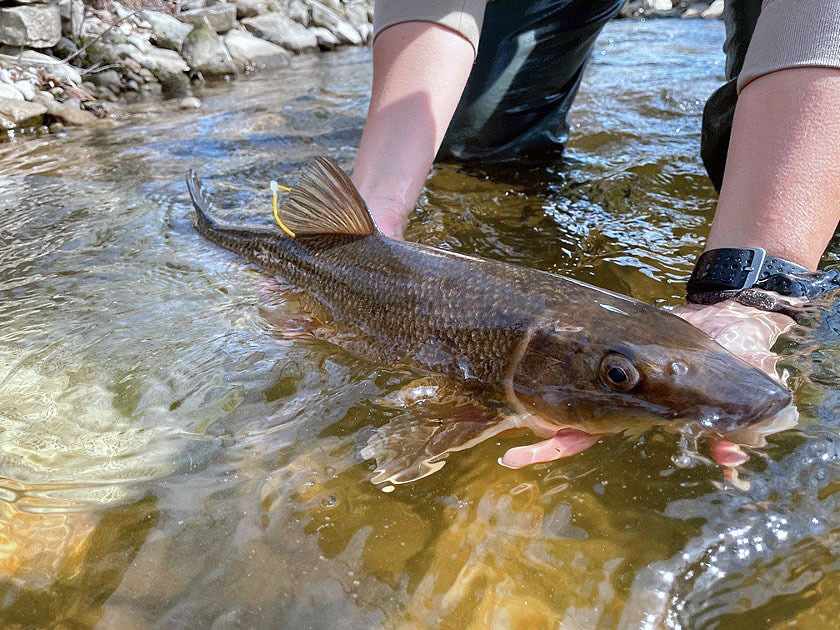
White suckers are the most abundant non-game migratory fish in the Great Lakes, serving as prey for many other species and providing spawning grounds with essential nutrients.
Dr. Karen Murchie of Shedd Aquarium is collaborating with an outstanding team across multiple agencies and institutions to gain greater insight into the movement and habitat usage over multiple seasons of this ecologically important yet understudied species.
Challenge
For fisheries to be healthy and sustainable, they require robust ecosystems where all native species can flourish. Management plans for recreational and commercial species can be improved through a clearer understanding of the spatial ecology of non-game fishes and their essential contribution to the overall ecosystem.
However, there is a lack of studies on non-game species such as white suckers and most have focused on degraded habitats or been limited to assessing movement only during spawning migrations. While these studies are valuable, baseline data is needed about white sucker behavior that also captures habitat usage outside of impaired areas and over an extended period.
Solution
To address this gap, Murchie and her collaborators are using both passive and real-time acoustic telemetry systems that are powerful tools for long-term monitoring of aquatic animals. The team is leveraging a vast array of Innovasea receivers already deployed in Lake Michigan by the Great Lakes Acoustic Telemetry Observation System (GLATOS) – a collaborative network that shares resources and knowledge.
In addition, the team installed an Innovasea Rx-LIVE receiver system near the mouth of a tributary of Sturgeon Bay, Wisconsin where 60 adult white suckers were tagged in 2022. From her Chicago office Murchie can remotely check on her charges anytime by logging into the real-time receiver dashboard that is affectionately referred to as “Sucker TV”. This spring the team tagged another 29 adults in a tributary of Green Bay, and this summer a new array of receivers is slated for deployment on the eastern side of the Door County Peninsula of Lake Michigan.
Result
Although the study is ongoing, Murchie and the team have gathered enough reliable data from the detections collected to learn that white suckers exhibit high spawning site fidelity behavior. This revelation corroborated insights gained from a passive integrated transponder study that Murchie had previously conducted.
The data also showed that even though the tagged white suckers returned to the same creek, they were not all associated with each other outside of the spawning season. This result echoes many telemetry studies where researchers often observe inter-individual variation where some fish are homebodies and others are more cosmopolitan.
After they collect their second full year of data later in 2024, the team looks forward to drawing even more conclusions and contributing to management plans.