Upgrading your Innovasea receiver array does not have to be an all-or-nothing endeavor. By strategically integrating NexTrak receivers into an existing VR2 array, researchers can increase detection efficiency, expand study coverage, and even make more effective use of their existing equipment.
With the right approach, mixed arrays can open new possibilities and provide greater flexibility to study designs for improved results.
Putting mixed array studies into action
How these principles apply will vary by study, but there are general considerations you should take into account. Let’s now look at two examples of varying complexity to illustrate how this works in practice.
Expand your study (without starting over)
Study parameters
- Objective: Measure migration timing and success through an estuarine river.
- Current array: 10 VR2 receivers deployed across migration gates.
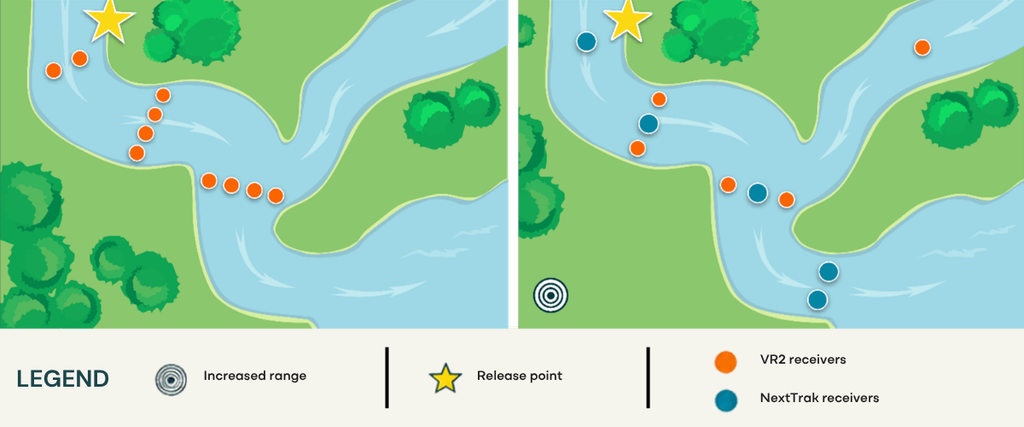
- Upgrade: Five NexTrak receivers replace five VR2 receivers.
In this scenario, a calculated upgrade significantly expands the study’s monitoring without changing the tags, programming, design, or analysis. At three existing gates, one NexTrak replaces two VR2 receivers, freeing up equipment to monitor an additional tributary and a fourth gate at the mouth of the estuary for better estimation of migration timing.
The result is a study with broader coverage, more detections, and new monitoring opportunities, all while making use of the existing VR2 array.
Fine-tune your study (around key events)
Study parameters
- Objective: Measure migration timing, spatial distribution, and spawning behavior.
- Current array: 14 VR2 receivers cover the spawning grounds and broader river downstream.
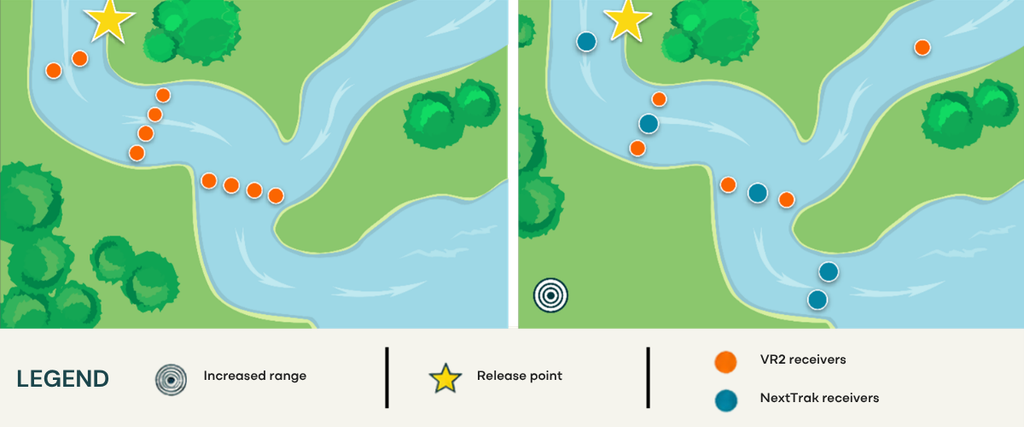
- Upgrade: Eight NexTrak receivers replace the 11 existing VRs at the spawning grounds, which can be moved elsewhere.
In this example, a mixed array supports higher resolution monitoring of spawning behavior and broader coverage of migration throughout the system.
Eight new NexTrak receivers are concentrated at the spawning grounds, where fish density is highest. Meanwhile, the extra VR2s are redistributed to offer broader coverage downstream.
By pairing NexTrak with Increased Residency (IR) programming, tag delays can be much shorter during the first 30 days (30-second average in this example), despite the high residency. As fish begin migrating downstream, the tags transition to a longer delay (120-second average) for the remainder of the study.
Through this setup, the study can seamlessly shift from high-resolution monitoring during spawning to broader, longer-term tracking as the fish disperse.
Looking for more mixed array study examples?
These are just two examples of how mixed arrays can give researchers more flexibility and opportunities to collect high-quality data. The right approach will ultimately depend on your study goals, environmental conditions, and equipment.
Furthermore, study design fundamentals still apply. Remember to:
#1 Range test before your study begins to inform receiver spacing and understand baseline environmental conditions and noise levels at your site.
#2 Deploy sentinel or reference tags to capture changes in detection efficiency.
Together, these steps give you a clear, ongoing picture of receiver performance, so you can interpret your detection data with confidence.
Download the guide to explore 11 unique study scenarios and learn how different configurations can be put into practice.