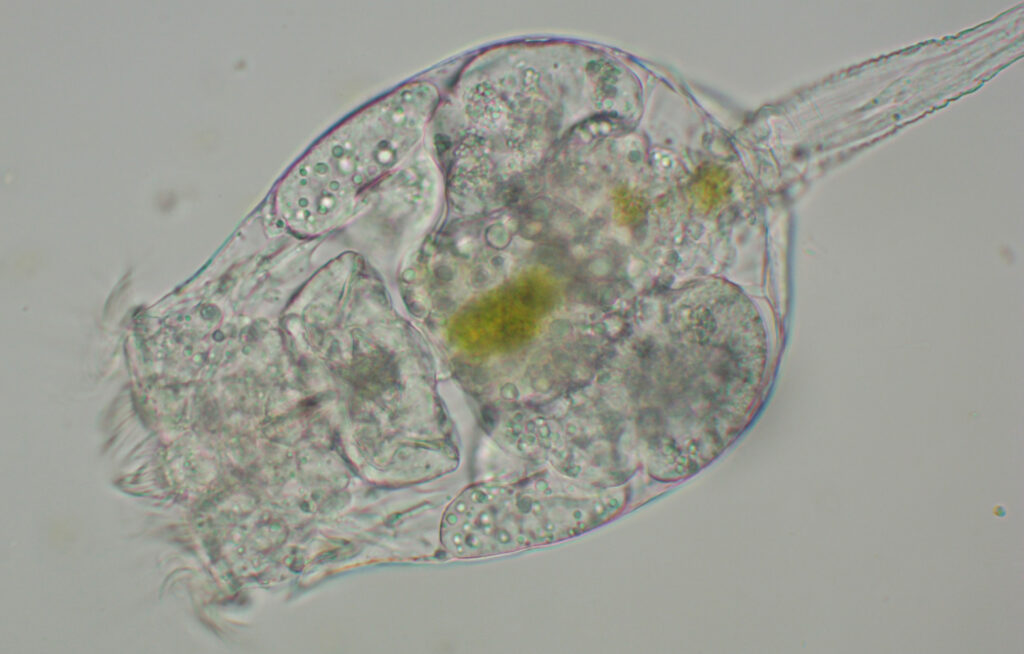
For most marine fish species, fish larvae can only feed on small particles that fit their mouth gap. Rotifers, a microscopic plankton species, are a crucial starting diet for marine fish because of their suitable size. In commercial-scale fish farms, however, each production cycle could require billions of rotifers as live feed. So a sufficient and stable supply of high-quality rotifers is one of the key elements to enhancing fish production. Rotifers are usually cultivated in high-density batch or semi-batch cultures using formulated enrichment media as their food source and chemicals to control ammonia and maintain proper pH levels. Commercial-scale rotifer cultivation requires experienced culturists to closely observe the rotifer culture and collect information such as rotifer density, fertilization rate and swimming speed. The amounts of input diet and chemicals need to be carefully calibrated based on the collected information. Observation and data collection are labor-intensive and inefficient, however, with rotifer culturists spending hours each day sampling, observing and counting rotifers under microscopes to obtain the data needed to manage the rotifer culture accordingly. In recent years, the advancement of machine learning algorithms has greatly enhanced the capabilities of machine vision, especially in applications such as object detection, localization, classification and tracking. Case in point: Innovasea’s feed optimization and biomass estimation capabilities. An artificial intelligence-driven machine vision system designed for rotifer cultivation could help culturists efficiently observe, interpret and evaluate the cultivation process by analyzing the microscopic images of rotifer samples. For instance, AI could be used to:
Ideally, continuous measurement and monitoring could provide more information about the cultivation and reduce the production risk. However, commercial hatcheries usually cannot afford continuous monitoring. As a result, the observation and measurements are typically conducted in a single-shot manner. For example, rotifer culturists count rotifers and take samples only once in the morning – and then make their operational decisions based on that snapshot of information so they can get back to performing other tasks in the hatchery. AI-driven machine vision would enable hatcheries to continuously monitor and measure the key indexes of rotifer cultivation so that the rotifer culture could be managed in a more precise way. The continuous data collection could also expand the rotifer culturists’ knowledge base and help improve the rotifer cultivation protocols. Just like advances in AI are helping improve other aspects of aquaculture, such as feeding and fish monitoring, the technology could improve the efficiency and quality of rotifer culture, decrease the need for human labor, and reduce the cost of the commercial-scale rotifer production.Challenges in Rotifer Cultivation
AI’s Role in Rotifer Cultivation
Single-Shot Measurement vs. Continuous Measurement

Aquaculture
Exploring the Species Selection for an Open Ocean Caribbean Fish Farm
We walk through the species selection process for a new, commercial open ocean fish farm.